
What is the Voidling Bound organic element?
The Voidling Bound organic element is one of the focused elemental alignments used when a Voidling evolves. The current public Elements reference lists Organic as highly effective against Lesion-spawns and Ancients, while it is weak against GenBots and Crystallines. Organic is therefore a matchup tool, not a universal best choice. It is most useful when the next mission contains the factions it counters.
Organic matchups: when the element helps
Element effectiveness is easiest to use as a pre-mission question. Look at the enemy faction, decide whether your damage window is long enough for Poison to matter, and check whether the route gives you room to keep applying pressure. A focused element can outperform a broad option in the right room, but only if the Voidling can survive the approach and keep its abilities active.
The table below summarizes the current public Organic boundary. Highly effective means the element has a favorable damage multiplier in the reference data; it does not mean every Organic ability is automatically the best answer. Weak means the matchup can cost you damage and time, especially in a room where enemies already punish close positioning.
| Encounter question | Organic guidance | What to verify |
|---|---|---|
| Are Lesion-spawns the main threat? | Organic is highly effective and its status effects can add pressure while you reposition. | Faction icons, ability range, Poison trigger |
| Are Ancients the main threat? | Organic is highly effective, so a focused Organic line can be a sensible evolution target. | Ancient patterns, safe damage windows, current tooltip |
| Are GenBots common? | Organic is weak in the current reference table; compare Cyber or Cryo options before committing. | Mission mix and the current element chart |
| Are Crystallines common? | Organic is weak here; do not select it only because the creature looks strong on paper. | Enemy faction and route objective |
| Is the room mixed? | Use the element that solves the most dangerous faction, or bring a second role for coverage. | Run goal, swap access, recovery cost |

How Organic Poison and Slow fit a fight
Organic is not only a color on the creature card. The public element reference associates it with Poison and Slow, so the useful question is how those effects change the fight you are actually running. Poison rewards time on target; Slow rewards readable spacing and safer follow-up shots. Both are more valuable when you can keep a target in view instead of repeatedly breaking contact.
Do not assume that every attack applies both effects. The Elements reference warns that an ability tooltip determines whether the elemental status is triggered. Check the equipped ability, its selected element, and the enemy's behavior in the current build. A primary ability may have a different rhythm from a defensive or ultimate ability even when the Voidling's main element is Organic.
Poison pressure
Use Poison when the target stays alive long enough for damage over time to pay back the ability timing. Keep line of sight and avoid spending every cooldown before the next wave.
Slow and spacing
Use Slow to make a dangerous approach more readable. It helps when you can kite, aim, or wait for a safe opening, but it is not a replacement for movement or cover.
Ability check
Read the equipped ability tooltip. The element association alone does not prove that every attack applies the same status or stack behavior.
Which Voidling lines can become Organic?
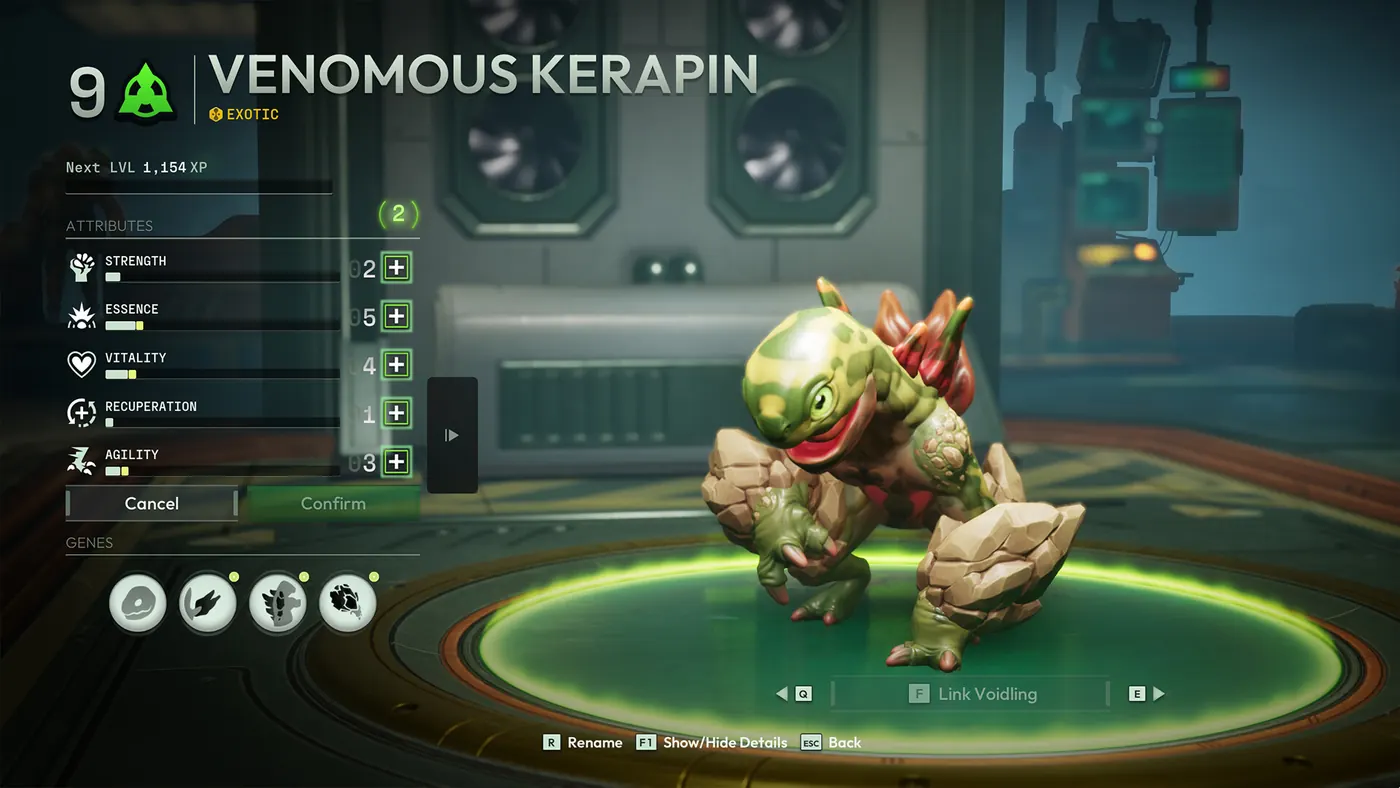
The current public Elements reference says that five species have an Organic evolutionary line. Community and wiki summaries identify those lines as Kwipeck, Kerapin, Gwigoon, Ur-Sek, and Nimiod. Use the list as a dated planning lead, not as a substitute for the active Evolution Chamber or a current species page. A branch, rarity, or patch can change what is available in your build.
The important distinction is between a species and an element. A species can have more than one possible line, and the Organic version may support a different ability rhythm from its other branch. Start with the role you need, then check whether the Organic branch supplies the range, movement, survivability, or control that the mission asks for.
| Organic line | Useful question | Safe next check |
|---|---|---|
| Kwipeck | Does a fast, flexible kit make Organic pressure easy to maintain? | Compare the Organic branch with the other available Kwipeck path. |
| Kerapin | Can the Organic line keep enough control or durability for the route? | Check attributes, movement, and the next evolution node. |
| Gwigoon | Does the Organic branch fit a status or utility role rather than raw burst? | Test the ability timing against the faction in the mission. |
| Ur-Sek | Does the line solve a specific encounter problem that Plasma cannot? | Compare safety, resource cost, and the planned role. |
| Nimiod | Do mobility and Organic matchup value work together in this zone? | Use the current tooltip and a short repeatable route. |
Choosing Organic evolution and Mutagens
An Organic build begins in the Evolution Chamber, not in a keyword list. The Steam description frames evolution as a branching system with elemental alignment and upgraded abilities. Before spending a Mutagen, write down the next mission goal and the branch that answers it. The best Organic choice is the one you can test and recover from, not the one that sounds strongest in an old screenshot.
Mutagens are part of a larger resource loop with missions, enemies, eggs, breeding, and research. Farm only what the next node requires, keep a reliable fallback, and avoid using a rare candidate as a blind experiment. If you need a general route through the tree, use the site's Evolution guide; this page stays focused on the Organic decision boundary.
- 1. Name the encounterWrite down the faction, route objective, and the failure you want Organic to solve.
- 2. Check the branchConfirm that the species has an Organic option, the required Mutagen is available, and the current ability tooltip matches the plan.
- 3. Keep a baselineRecord the current Voidling, attributes, Nature, and ability set before you evolve.
- 4. Test one variableRun a repeatable encounter and observe matchup damage, status timing, movement safety, and resource use.
Organic build choices by use case
There is no single best Organic build because the element answers a matchup, while attributes and abilities decide whether you can exploit it. Use the cards below as a shortlist of questions. Then connect the answer to the site's Types, Max Level, Breeding, and Catalyzers guides instead of copying a fixed spread.
A focused Organic line is most convincing when the mission has a clear Lesion-spawn or Ancient problem. If the route is mixed, a second Voidling can give you better coverage than forcing Poison into a weak matchup. If the issue is survival, add the attribute or defensive tool that fixes the failure rather than assuming the element will carry the run.
Faction specialist
Choose Organic for a route dominated by Lesion-spawns or Ancients, then build enough safety to keep applying damage.
Status pressure
Choose abilities that make Poison or Slow meaningful, and confirm the trigger in the tooltip instead of assuming every attack stacks it.
Flexible explorer
Keep Organic as one role in the roster, but carry a second option for GenBots, Crystallines, or mixed rooms.
What this Organic guide does not claim
The Organic matchup and status association are supported by the current public Elements reference, while Steam supports the overall evolution, attribute, mutagen, egg, and breeding context. Exact damage numbers, stack caps, drop tables, and hidden modifiers can change. This page therefore avoids presenting a permanent spreadsheet as official truth.
Species names are useful for routing, but the five Organic lines are community/wiki evidence and should be checked against the current Evolution Chamber. If the game or an official patch note disagrees, the current build wins. Keep the checked date visible when you publish a new observation.
Patch-aware wording
Use current tooltips and repeatable tests for exact values; label older community notes by date.
No universal tier list
Organic is strong in its favorable factions and weak in the listed counters. The mission decides the value.
No invented drop rates
This page does not promise a Mutagen route or species drop that the cited sources do not verify.
Sources and verification boundary
This independent guide combines first-party game context with dated public wiki and editorial references. Use the official sources for identity and system framing, then recheck exact Organic values in the active game build.
- Official Steam pageConfirms branching evolution, elemental alignment, attributes, mutagens, eggs, breeding, gene collection, and combat context.
- Voidling Bound wiki.gg ElementsDated community reference for Organic matchups, Poison and Slow, and the five Organic evolutionary lines.
- All Things element explainerIndependent SERP reference for the element table and species pairing; verify patch-sensitive details in game.